Monday, 28 February 2011

Camper shoes, Chinese 18th century tankard, tulips.................... painting


This painting features a pair of Camper shoes of 2001.  These shoes were created in Mallorca the Spanish island in the Mediterranean, camper being the Catalan word for peasant.They  were    inspired by farmer footwear and steeped in island tradition. The firm  was started  in 1975.

Sunday, 27 February 2011

Chinese 19th century painting on rice paper


This is a small 19th century Chinese watercolour painting on ricepaper painted in the Western style. These fragile paintings are always exquisitely executed, subjects ranging from natural history, land/ seascape etc.

Saturday, 26 February 2011

Fashion for women 1806, 1929, 1942.......Plus ca change....?


At this time of important fashion shows throughout Europe and the US for Autumn /Winter 2011-2012  here are three fashion plates showing how womens'  fashion has changed radically , or has it?  since 1806.

1. A  French pale pink empire style dance dress, rear view, showing a demure and fragile girl holding a small fan and spray of flowers. her matching hat  adorned with pink draped  feathers , the  upper sleeves slashed and puffed on upper arm and the lower edge of her bodice cut in slightly medieval style. Very 'feminine'! 

2.The front cover  of the famous French store Printemps Summer 1929. Here  two women  wear straw cloche hats and elegant day dresses. One dress is made in crepe de chine, the other in crepe de laine, both  are well tailored with lowered waistlines that have  plenty of swing  in the skirts. The hemlines are spot on for this year's fashion 2011-12,  they both hold small box leather handbags. This period was between World War 1 and 2 so it was a comparatively carefree and wealthy period.

3. Two women in completely different mode. World War 2 is well under way,  and the two women look quite practical and  masculine in their 1942 Winter wear. Their blond hair is severely swept up and they both wear  high silk cravats at the neck. One wears a precariously perched astrakan hat that matches the collar etc on her slightly military styled suit with its broad shoulders. Hemlines are again de rigueur for season 2011-12, and even the rather heavy weight brogues and sturdy walking shoes worn with ankle socks wouldn't look out of place on the cat walk for  this Autumn - Winter 2011-2012!
Plus ca change, plus c'est la meme chose - The more things change, the more they stay the same?

Friday, 25 February 2011

Tories are warmongers, and David Cameron is weak.

They say that leopards never change their spots and the Tory Party have just managed to prove that point!
No sooner than the Eygptian 'revolution' starts to settle than David Cameron waltzes into the country and starts nosing about with his killer entourage of Arms dealers and other nefarious business men hungry for new contracts! As if Britain hadn't caused enough damage in these countries already!
These business men form a fraction of the massively honed lobbyists that haunt the corridors of our parliament,  steal away our democracy, and inevitably cause corruption in their wake.
These are dangerous groups, the arms dealers, the huge medical bio-tech manufacturing and drugs groups, the gm and cloning lobbyists, the banking industry, the alcoholic drinks lobby,  there are many more.
Who actually runs the country? Is it parliament anymore? it is certainly not the people. Ministers always seem to have an axe to grind, and laws are never now brought in for the good of the people.
Mr Clegg, despite the problems in the country caused by cut-backs gaily sets off on his hols! He is the Deputy Leader, and North Africa is in a state of turmoil! So while David Cameron gets shuffled around Eygpt by arms dealers, Mr.Clegg (that wet piece of seaweed) goes off skiing with his family, and  the country is left to the articulate fox William Hague!
Parliament is losing out, ministers all have their axes to grind, their lobbyists to feed, the people, through their mps have little say in best decisions for the people. Sadly it won't be any good turning to the Labour Party, because they are exactly the same. Is it time for the people of Britain to get out there and protest?

Wednesday, 23 February 2011

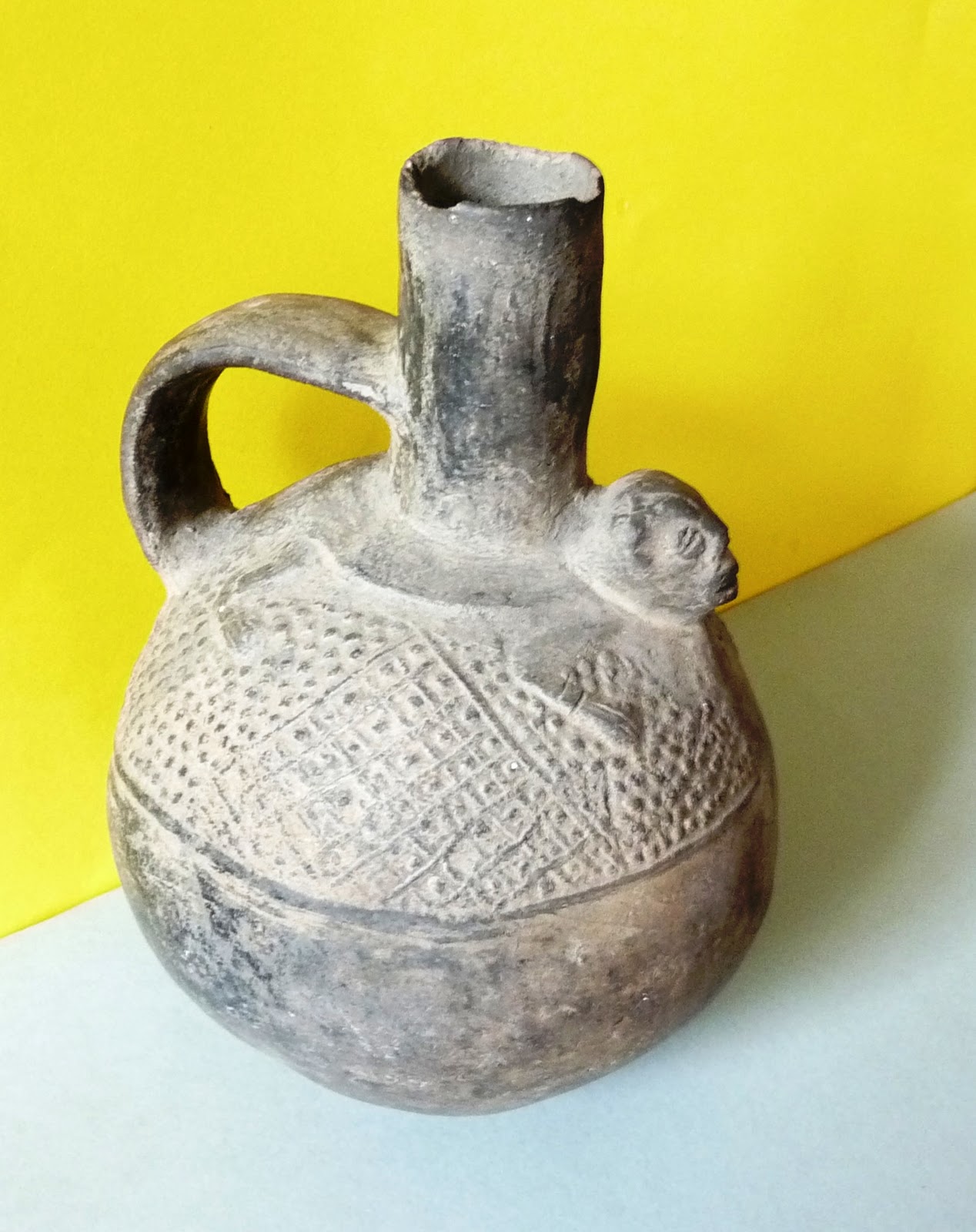
Ancient Peruvian pottery, small jar with animal decoration


Three views of an Ancient Peruvian pot 8 inches high made in dark brown clay with monkey like creature at base of spout and incorporated into curved over handle.

Tuesday, 22 February 2011

Wild Flowers picked in French Hedgerows, pencil drawings by Tessa Bennett


 Wild flowers picked in French hedgerows.

1. Common dog violet.
2. Wild Strawberry.
3. Greater celandine.
4. Broom.
(all drawings by Tessa Bennett)

Monday, 21 February 2011

Mahatma Ghandi, Indian 'King' of People Power.

Mohandas Karamchand Ghandi,  (Mahatma Ghandi, Great Soul), was born in Porbandar India in 1869. He was the political and idealogical  leader of India during the Indian Independence Movement.
He studied law in London returning to India in 1891 to practice as a barrister.
As an expatriate lawyer in South Africa he first employed civil disobedience pioneering 'satyagralia' - resistance to tyranny through mass civil disobedience founded on 'ahimsa' (truth and total non-violence).
In 1915 he returned to India to organise protests for peasants and farmers concerning excessive land tax and discrimination. In 1921 he became the leader of the Indian National Congress, and among other causes,  'swaraj' (Independence of India from foreign domination), he led his followers on the famous march and non-cooperation movement against the imposition by the British of the salt tax. He spent a number of years in jail in South Africa and India. He lived modestly, wore a traditional Indian Dhoti and shawl spun by hand himself, fasted frequently, and was a vegetarian. A great man. He was assassinated in January, 1948.
 
' Strength doesn't come from physical capacity, it comes from an indomitable will'. Mahatma Ghandi.


Above....picture of Indian hand-embroidered muslin c1815. This example of the fine loosely woven cotton cloth  muslin was made for the export market for ladies dresses etc, in c1815. Made mainly in Dacca India, muslin was loved for it's daring transparency and exquisite embroidery. In 1787 the value of the imports of muslin into England was estimated at $2,000,000 annually.  Unfortunately, with the introduction of the spinning jenny in England a heavy duty was imposed on all Indian goods and manufacture of Dacca muslins for export purposes was killed.